Summary
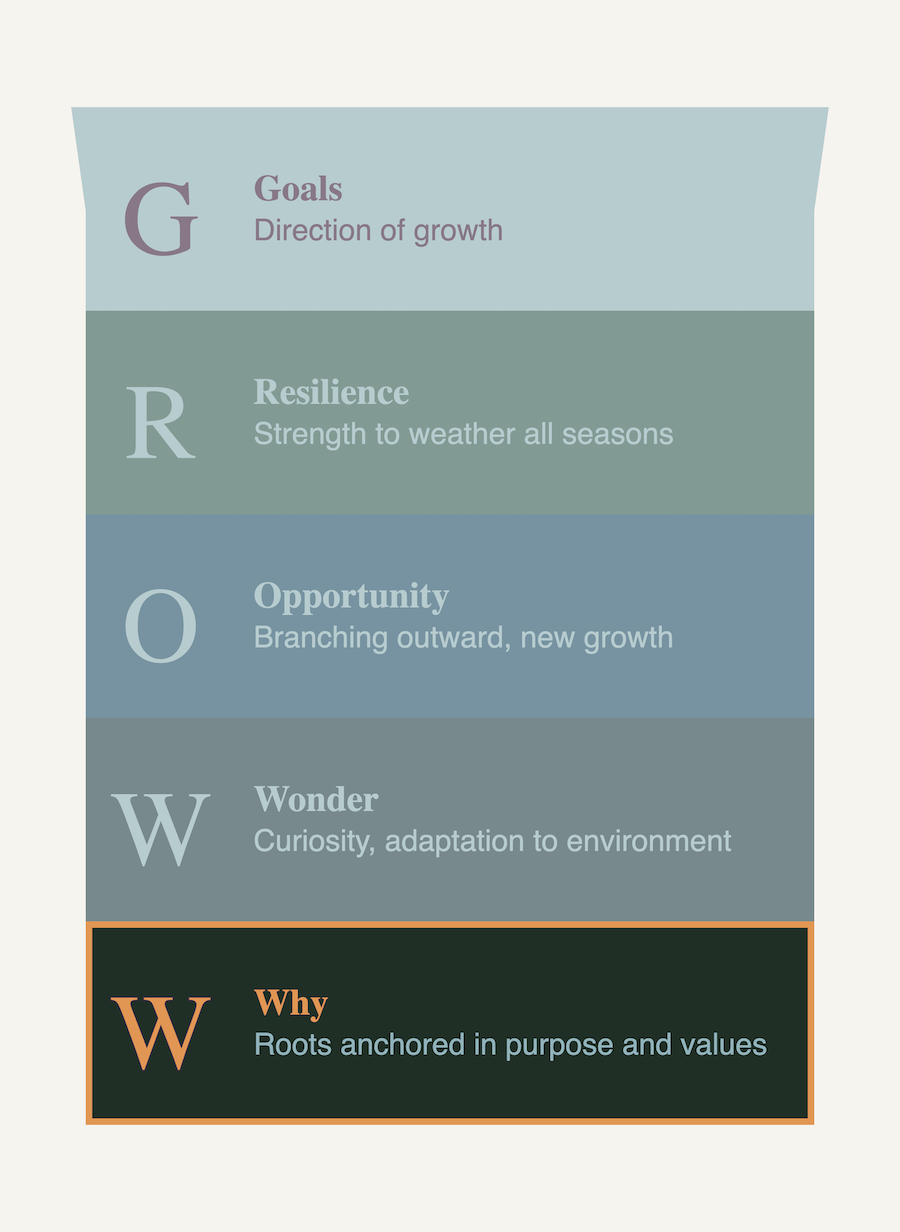
The purpose-driven solo HR professional running the entire Human Resources function alone rarely gets confirmation the work is landing. This post explores the Why pillar of the GROWW Framework, Goals, Resilience, Opportunity, Wonder, and Why, and makes the case for defining your own Why deliberately, in writing, instead of waiting for recognition that may never come.
Post 6 of 7: Why | Growing on Purpose: The GROWW Framework for HR Departments of One
Most people don't choose Human Resources. Human Resources chooses them.
An organization grows past the size where one person can informally handle hiring and questions about benefits between other duties, and it needs someone to formally own that work. The person who gets the role is rarely a new hire that applied to a Human Resources posting with a resume built for it. More often, it's someone who was already trusted, who already knew where every policy and every relationship stood, who cared enough to notice what the organization needed before anyone asked. Initiative and institutional memory are the job requirements. Just like that, someone becomes the entire Human Resources function for an organization that used to get by without one.
That's how it happened for me.
I didn't set out to build a career in Human Resources. I ended up there because I cared, because the people I worked for trusted me, and because I already understood the organization in a way a new hire couldn't. When my organization grew large enough to need someone dedicated to its people, I was the clear candidate.
I loved it, at first. I loved being the person people came to. I loved solving the kind of problems that made someone's work life better in a real, specific way. I loved building systems and programs that supported my team. And then, like it does for so many solo HR professionals, the workload caught up with me. The recruiting and the compliance and the benefits questions and the conflict I was pulled into and the neverending policy updates all stacked up. I started asking myself what impact I was having and why it mattered.
I found Simon Sinek's work during my second HR Department of One role, at a point when I badly needed a reason that wasn't just a paycheck or loyalty to keep going. His central idea, that people are moved more by why an organization exists than by what it does, reframed something that created an important shift for me. I didn't just need to understand the organization's Why. I needed to define my own purpose within my specific role.
Why the Purpose-Driven Solo HR Professional is Under-Appreciated
At one organic food company I worked for, we made a dairy-free ice cream that was the best on the market by many accounts. Our customer service inbox filled with letters from people who hadn't been able to enjoy ice cream in years, some of whom cried tears of joy the first time they tried our product and felt they could enjoy their favorite dessert again. We started reading those letters out loud in team meetings. It was an intentional strategy to share those letters. It kept everyone connected to why the work mattered, especially on the days the work or circumstances were hard.
Human Resources rarely gets that kind of letter.
The Why behind the work can't depend on appreciation from others. It has to be built.
The Human Resources or People Operations function exists almost entirely in service to other people within the organization, and the nature of that service means it's often invisible. When a policy protects someone, they usually never know what would have happened without it. When a system runs well, no one notices the friction that used to be there. The complaints arrive, but the gratitudes are few and far between. For the HR Department of One in particular, there is rarely a peer nearby to say, out loud, that the work they’re doing is valued and appreciated.
This is not an easy issue to solve. It's cultural, psychological, and structural. In an overloaded role that’s meant to serve others, there’s no time to solve problems that big so the person in the role receives more appreciation. The Why behind the work can't depend on appreciation from others. It has to be built.
The Evolution of My Why
I've written a version of my HR mission statement more than once over the years, refining it as I understood myself and the role better. Every version spoke to how the role serves both the people and the organization. The people part has remained steady: maximizing the potential of my team members. For the organization part, I cycled through minimizing risk, building systems, and solving problems. Eventually, I realized all of this could be summarized by maximizing the potential of the organization as well.
I know when I've improved something that was holding an organization and its people back, because I can watch the friction disappear. I know when I've found a solution that serves both a team member's real need and the organization's real constraint, because both sides get better at the same time. That kind of proof doesn't require anyone to tell me it worked. It shows itself.
That's where my mission statement landed, and where it still lives today, evolved now for the work I do coaching leaders and organizations instead of running Human Resources: to maximize the potential of the people and the organizations I work with through win-win solutions that support both.
I know when I've found a solution that serves both a team member's real need and the organization's real constraint, because both sides get better at the same time.

Your Why Doesn't Have to Wait for Someone Else to Name It
If you're the purpose-driven solo HR professional running the people function alone, you know what it feels like to do work that rarely gets reflected back to you. That's a sign you're delivering results that simply aren't being reflected back to you. The role needs a Why that doesn't depend on outside validation to hold up.
That's a sign you're delivering results that simply aren't being reflected back to you.
Writing an HR mission statement down and posting it somewhere visible can significantly shift whether or not a solo HR professional feels they’re succeeding.
If you've been doing this work for years without ever writing down why, you don't have to work it out alone. The HR Department of One Reset is a three-session coaching package built around this arc, starting with what's feeding you and draining you, moving through what's already working, and ending with putting your purpose into words you can actually stand on. Book a discovery call to see if it's the right fit. Let's find the language for the Why that's been carrying you the whole time.
About GROWW Leadership
GROWW Leadership helps mission-driven leaders and organizations turn intention into impact through leadership and sustainable growth coaching, training, and organizational design. Founded by Kristie Steele in Eugene, Oregon.