Summary
For the solo HR professional, goal setting runs into the same obstacle every year: important goals have no deadline forcing them onto the daily list, so they keep losing ground to whatever is most urgent. This is the second post in the Growing on Purpose series, examining the GROWW Framework — Goals, Resilience, Opportunity, Wonder, and Why — through the lens of the HR Department of One at a small purpose-driven organization. The post explains why important goals disappear year after year, what the Eisenhower Matrix reveals about where they go, and why the goal aligned with a person's natural strengths is the one most likely to survive a hard year.
Post 2 of 7: Goals | Growing on Purpose: The GROWW Framework for HR Departments of One
For three years running, my own annual goal had quietly disappeared. Some years I was asked by leadership to prioritize something else. Some years it was simply circumstance, the ordinary churn of a small organization where the urgent always jumps the line. The pattern was the same each time. I would set a goal that was important for the organization’s growth and then the year would fill up with everything else. By December, that goal was the one thing that never got its turn.
I would set a goal that was important for the organization’s growth and then the year would fill up with everything else. By December, that goal was the one thing that never got its turn.
Last year had every reason to be the same. My director went on a three month leave, and I stepped in as interim director of a department that was already short staffed and included Admin, Finance & Compliance, and People Operations. A week into her leave, the controller we had just hired resigned, and I picked up supervision of two people I had not been managing the week before. The leadership team had also set an ambitious organizational goal that landed a significant amount of work on my function.
By the old pattern, my goal should have vanished completely. It did not fade though. That was the year I did something different.
Why the Important Work Is Always the First to Go
There is a well known way of sorting work that explains this pattern. The distinction between urgent and important traces back to Dwight Eisenhower, and Stephen Covey later shaped it into the four quadrant grid many people know today as the Eisenhower Matrix. Tasks are sorted by two questions: Is it urgent? Is it important?
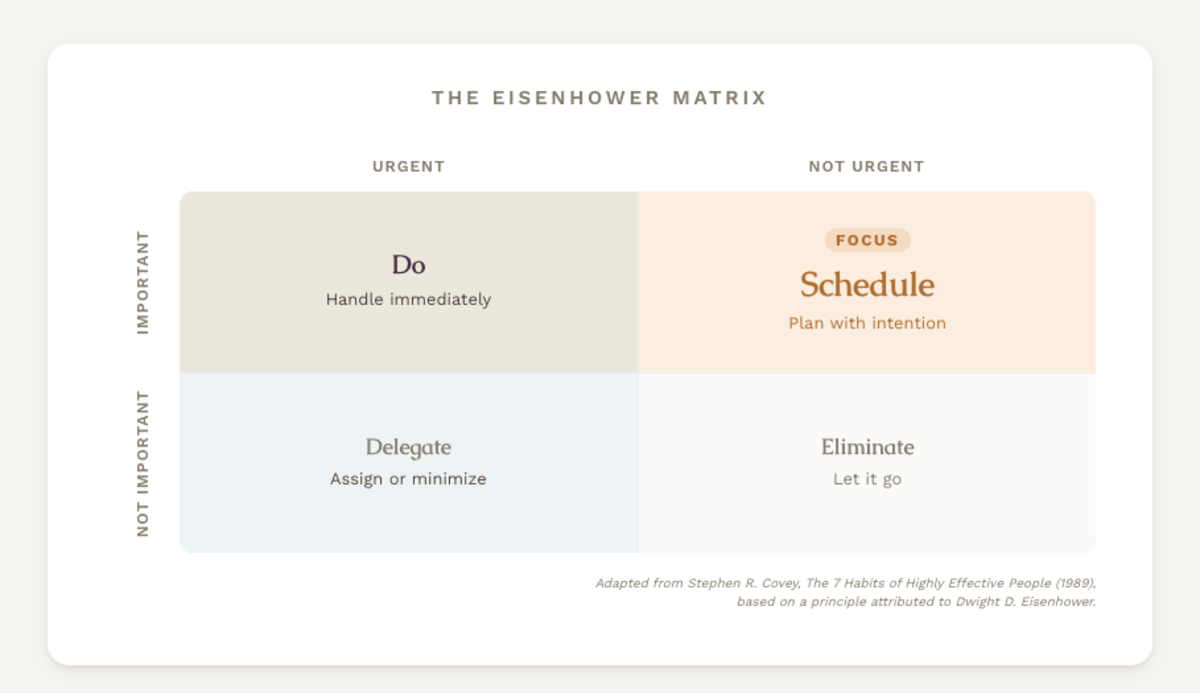
Most of a day disappears into the things that are both urgent and important, the genuine fires. The trouble lives in a quieter quadrant. The work that is important but not urgent has no deadline forcing it onto today's list, and so it waits. Retention planning waits. Building a development program waits. Your own professional growth waits. None of it is on fire, so none of it gets the time it needs, and that time goes to whatever is loudest instead.
For an HR Department of One, this is the quadrant where the most valuable work quietly dies. It is also where my annual goal had been dying for three years.
Covey put the solution in one line that now lives on my bulletin board: the key is not to prioritize what is on your schedule, but to schedule your priorities. Reading it is easy. Doing it, when the inbox is full and three people need you before lunch, is the actual work.
What Made the Difference Was a Goal Built on My Strengths
My goal that year was the work I had been hired to do in the first place. When I took the role, the organization expected to grow many times over within a few years, and they wanted to develop a strong leadership culture to support that growth. However, the systems were not ready for it. The first stretch of my time there went to fixing foundational systems so they could support the expected growth. The work I actually felt excited to do, designing a learning and development program for the organization’s people leaders, had been waiting in that important but not urgent quadrant the whole time.
What kept it alive last year was that the goal not only sat squarely in my learning and development strengths, but it also stretched another strength in a new direction. One of my strongest tendencies is a deep sense of responsibility, which almost always points outward towards obligations I have made to other people. The shift was turning it inward for once, and letting it protect a goal that I felt was important despite external pressures. There were more goals than ever that others or circumstances asked me to prioritize, and yet this shift in pointing my strength inward enabled me to make meaningful progress on my goal.

A goal aligned with how you naturally work does not feel like one more thing to drag yourself toward. It gives energy back rather than taking it.
This is the part that tends to get missed in goal setting advice. A goal aligned with how you naturally work does not feel like one more thing to drag yourself toward. It gives energy back rather than taking it. A goal that gives energy is the one that survives a brutal week, because returning to it feels like relief rather than effort. I did not finish the entire program that year. I made real progress on it, which after three years of watching it vanish was its own kind of victory.
How Solo HR Professionals Protect Time for Goals
If protecting important but not urgent work is something you would like to try, the practical move is to give that work a place on the calendar where the urgent cannot reach it. Here is the specific version I would offer.
Block three recurring focus sessions per week, of at least two hours each. During those sessions, protect the time the way you would protect a meeting with your most important stakeholder. Turn off notifications. Close the inbox. Shut the door if you have one. The point is to make the time genuinely unreachable, not nominally blocked.
Then treat the target as an average rather than a rule. Target an average of two blocks per week spent on important but not urgent work. Setting it as an average matters more than it sounds. The first week something time sensitive eats one of your blocks, and something will, you have not failed. You have a margin built in, and you can carry the intention forward instead of getting discouraged and abandoning it.
If three blocks feels impossible in your current week, start with two and set your target to an average of one per week. The number is not the point. Starting is the point, and a single protected 2-hour block spent truly focused on strategic work is worth more than three blocks you set up and then abandon a month later.
One more piece, and it is the one that makes the rest hold. Spend that protected time on work that draws on your strengths whenever you can. I will admit I have booked a recurring block for my own development and then, more often than not, spent it on something urgent instead. The blocks that survived were the ones pointed at work I found genuinely energizing. The calendar holds the time. Your strengths are what keep you from giving it away.
The calendar holds the time. Your strengths are what keep you from giving it away.
The Goal That Survives Is the One You Protect
The catch-up trap from the first post in this series is not solved by working harder inside the trap. It is loosened by deciding, in advance, that some of your hours belong to the work that matters even when it is not on fire. For three years my own goal lost that contest. The year I gave it a protected place on the calendar was the year it finally moved. Not all the way. Just further than it ever had, which turned out to be enough to change how I work and the impact I have.
I put the focus block method into a one page guide you can use to get started. It lays out the approach, a simple distraction checklist, and the averaging idea so a missed week never means starting over. You can download it below.
The next post in this series turns to Resilience, the strength to weather all seasons, and what sustainable leadership habits actually look like when your bandwidth is already stretched.
About GROWW Leadership
GROWW Leadership helps mission-driven leaders and organizations turn intention into impact through leadership and sustainable growth coaching, training, and organizational design. Founded by Kristie Steele in Eugene, Oregon.